Noise: Fast filter adds synthetic colored noise to the image using a lightweight, performance-oriented algorithm.
The filter introduces random variation directly into color channels, producing visible RGB noise rather than luminance-only grain.
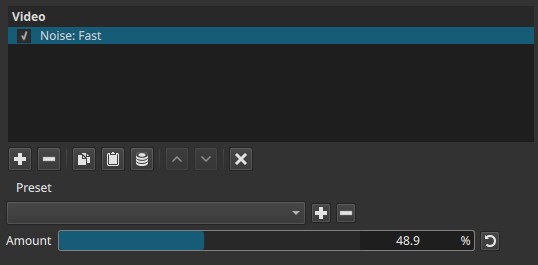
This filter prioritizes speed over physical accuracy. It is designed for real-time playback and simple texture breakup, not for film-accurate noise simulation.
Parameters
Amount (0.0 - 100.0%)
Controls the intensity of the noise contribution.
-
0%
No noise is added. -
Low values (1% - 10%)
Subtle texture breakup. Useful for reducing banding or digital smoothness. -
Medium values (10% - 40%)
Clearly visible colored noise. Flat areas begin to shimmer with chromatic variation. -
High values (40% - 100%)
Strong, obvious noise. Image detail becomes secondary to noise structure.
Important behavior
- Noise is applied per color channel, not as pure luminance noise.
- The noise has no film-grain weighting; shadows, midtones, and highlights are affected similarly.
Note:
Amount controls how much random color variation is injected, not the size or scale of the noise.
Keyframes
This filter does not support keyframes.
Noise intensity and behavior remain constant over time.
Type of noise (technical note)
- Colored (RGB) noise, not monochrome
- No correlation between channels
- No film-style luminance weighting
- No temporal evolution control
Editor’s note:
Visually, this noise resembles GIMP’s CIE LCh Noise filter at low chroma correlation, although the underlying algorithms are different. The similarity is only visual, not algorithmic.
This is not:
- Film grain
- Sensor noise simulation
- Dither (no pattern, no tone approximation)
Visual characteristics
- Fine, high-frequency noise
- Random color speckling
- Even distribution across the frame
- No structured pattern or clustering
Noise is especially visible in:
- Flat color regions
- Gradients
- Shadows
Recommended use cases
- Breaking up gradient banding after heavy compression
- Adding texture to flat or synthetic imagery
- Masking posterization artifacts
- Creating digital or degraded aesthetics
Common combinations
-
Noise: Fast + Posterize
Reduces harsh band edges by introducing stochastic variation. -
Noise: Fast + Dither (low Levels)
Adds randomness to ordered dithering patterns, reducing visible regularity. -
Noise: Fast + Gaussian Blur (very subtle)
Softens chromatic speckling while retaining texture. -
Noise: Fast + Color Grading
Can be used deliberately to introduce instability or analog-digital hybrid looks.
Limitations
- Not film-accurate grain
- No control over noise color balance or channel weighting
- Can amplify compression artifacts at high Amount values
- May shimmer noticeably after export or platform re-encoding