Gradually reveals a clip at its beginning by transitioning from black or transparency to the full image over a specified duration.
This filter is commonly used to create smooth visual entrances and to avoid abrupt cuts at the start of a clip.
Access methods
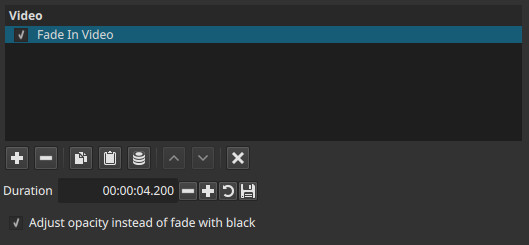
- From the Filters list as Fade In Video
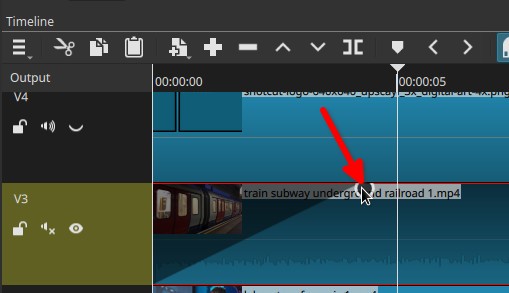
- Directly from the timeline by hovering near the top-left corner of a clip’s start and dragging the rounded handle inward the clip (to the right).
- This action automatically adds the filter to the clip with the chosen duration.
- Double-click the fade control’s circle handle to either add a one second fade or remove the fade.
General behavior
- The fade is applied from the clip’s start only.
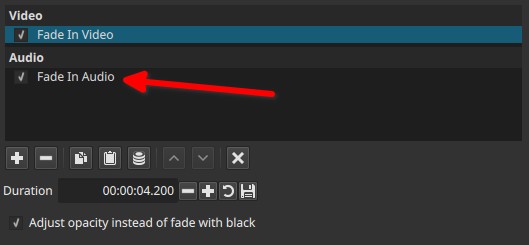
- If the clip contains audio, audio is faded in as well, and a corresponding Fade In Audio filter is automatically added.
- The fade affects the clip locally and does not alter adjacent clips.
Parameters
Duration (time value)
Sets how long the fade-in lasts.
-
Format: HH:MM:SS.SSS
- Example:
00:00:04.200= 4.2 seconds - Depends upon Settings > Time Format. If using a timecode format, it is HH:MM:SS::FF where FF = number of frames since the last second and the maximum before returning to 0 depends on the project frame rate.
- Example:
-
Defines the interval from the clip’s first frame to full visibility.
-
Short durations create quick, subtle fades.
-
Longer durations produce slow, deliberate entrances.
-
Changing Duration updates the fade curve proportionally.
The adjacent Set as default button stores the current duration as the default for newly added fades.
Adjust opacity instead of fade with black (checkbox)
Changes how the fade is performed.
-
Disabled (default)
The clip fades from black to full image. -
Enabled
The clip fades by adjusting opacity:- The clip becomes gradually opaque
- Underlying tracks (if any) show through during the fade
Important behavior note (how the filter is added matters)
The default behavior of Fade In Video depends on how the filter is created:
Added from the Filters list
→ The filter defaults to fade from black
→ Adjust opacity instead of fade with black is disabledAdded directly from the timeline clip handle
→ The filter defaults to opacity fade
→ Adjust opacity instead of fade with black is enabled if the clip is NOT on the bottom video track (V1). Otherwise, on V1, it fades with black.In both cases, the same filter is used; only the initial checkbox state differs.
Audio behavior
When the clip includes audio:
- A matching Fade In Audio filter is added automatically
- Audio fades in over the same Duration
- Audio and video remain synchronized
This happens whether the filter is added manually or via the timeline handle.
Visual characteristics
- Smooth, linear transition by default
- No geometry or color changes
- Predictable timing aligned to the clip start
- Behavior is identical whether added via filters or timeline interaction
Recommended use cases
- Softening the start of a clip
- Introducing scenes without hard cuts
- Matching visual and audio entrances
- Compositing overlays using opacity fades
Limitations
- Applies only at the start of a clip
- Duration is time-based, not frame-count based
- No curve or easing control
- Not keyframeable