Oh wow! Amazing - made my day! Thanks so much. Downloaded, will enjoy this performance. 
Thank you very much @Y.S and Evgeniya.
Really enjoyed that.
I’m curious, from a technical perspective, did you apply a relatively high-Q notch (at around 10KHz) and then low pass just above that?
We will crash your party! 
1 Like
I’ve played with Windows gain setting (level/volume), along with software noise reduction filter (in OBS), the recording got a bit better.
After online search regarding the noise, some suggested to get a AudioQuest JitterBug Data & Power Noise Filter for the USB mic. Have you had any experience with it? I might just get one and try it.
Wow, thanks for the music!
1 Like
No. 
Let me tell you the story of this recording…
In fact, the concert from which this track is extracted is the first concert of VivaMuse recorded by me. I was very nervous, did silly things and had major technical problems (partly because I was nervous and did silly things).
So this material is broken. There is video for the first part of the concert, with a sound recorded by DSLR, and the sound for the second part of a concert, recorded by Zoom, with no video (well, there is just one piece which has both video and proper audio).
This particular track originates from the first part of a concert, so there is no good sound available. I just extracted the sound from a video file, applied some reverb, and then some stereo widening (and also loudness normalization, fade in/out, fixed noise a bit, etc).
Of course, applying stereo widening to a track having almost no differences between L/R gives poor results, but at least it does sound a bit less “in the middle of the head”. It is this step which may be responsible for that perceived filtering.
This is an unprocessed sample.
https://drive.google.com/file/d/1g_-_uAYcY1yC_5EASzejeLGhtvOysoGA/view?usp=sharing
Well… I have no experience with it.
But I did a quick search. On Amazon it costs approx. $140, and Zoom H1n costs $170 or so. By adding $30 you can get a stand-alone recording device free of all EMI problems, also capable of being used as a second USB mic (stereo mic, by the way).
Hi @Y.S - interesting thread ! Art meets science!
Can I ask what reverb you added? sounds really good…
I don’t have experience with the AudioQuest, but have in the past, tried other USB power filters/conditioners.
Although they do work, they don’t remove all the noise, depending on how bad it is.
For a mic, due to it’s very low level (before it goes into the ADC and out to USB),
you may find quite a bit of residual noise left.
For the price, I also say rather go for the option/s @Y.S wrote about.
You would be very welcome! A baroque string music party!! 
1 Like
Depending on your electronics knowledge, you can also make your own USB power filter.

They are not complicated but are tricky little beasts.
The problem comes in with amount of reduction you need versus data drop out.
USB devices have quite tight tolerances on the (dv/dt) time allowed for the power to
rise from zero to about 90% of 5V.
The problem here is that the ferrite bead and capacitors introduce a delay.
The trick is to filter enough but still keep within the allowed tolerances.
Same applies to the choke and capacitors on the data lines.
Too little inductance and capacitance, it will not filter enough noise,
too much and the data starts to get corrupted and you get drop outs.
Luckily your mic is a low speed device (12Mb/s) so it gives you more leeway
than say with a full speed device (480Mb/s), or even worse, USB3.
Other things you could try, if using a laptop, run on battery power for the duration of the recordings.
Don’t use a USB hub on the same port as the mic with other things like keyboard, mouse or HDD connected.
Rather put them on different USB ports.
I use SAFEReverb.
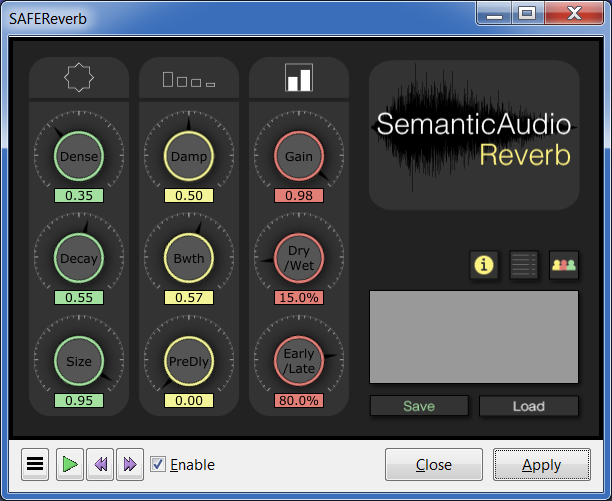
Nothing special about it, it’s just the first free and decent reverb VST that I’ve found.
As for the settings, the logic is as follows.
We’re going to emulate a large hall, big and beautiful. So turn the Size up, near the max.
In such hall, musicians are typically seated at the stage, which is also large in size, flat and mostly empty. So there will be not a huge amount of early reflections - so turn the Dense knob down.
This is a large and mostly empty hall, so the decay time is substantial. Thus, set the Decay knob to some decent amount. As you can see and hear, for this plugin something around 0.5 is good enough.
Our imaginary hall is very beautiful, with velvet seats and wooden decorations. This all diffuses and absorbs high frequencies. So turn Damp knob up and Bandwidth knob down.
And now let’s face the reality. The real recording was made in a less-then-perfect environment (a chamber hall). So there are some not so pleasant early reflections. Let’s set Early/Late balance to have about 20% of simulated early reflections to dilute the real ones. For the same reason, Pre Delay should be set to zero.
As for the Gain control, it can be left at default setting. Dry/Wet balance is adjusted as taste suggests (in fact, the same can be said about Early/Late control).

Oh. I would better refrain from messing with USB data lines. It’s a tricky business, and it is very easy to make things even worse.
Hi @Y.S
Thanks for sharing the story, always interesting to hear about the history behind it.
Tell you what, comparing the processed and the raw clip, you did a really good job.
I couldn’t help but have a go too.
Apologies if I murdered the clip but my experience is mostly rock and pop.
This was loads of fun to mess about with.
Processing done in this order:
- Got noise profile from beginning of clip
- Removed some noise (about 7-8dB).
- Added some low end (as the noise removal made it a bit thin) around 40-120Hz.
- Then added a bit of reverb so that all frequencies had about the same amount.
- Applied a bit of upward compression.
- Added slight amount of stereo widening.
- Lastly, added a bit on the high mid range (from about 3.5KHz) to brighten it up a tad.
Like I said, this is not the genre of music I normally work with so the result may be a bit “bright” for some.
As far as noise reduction goes, it’s on the limit as it’s just about to become too “phasy”.
Result below in flac format (zipped).
Sorry but it has to be a much shorter clip due to the upload restrictions on this forum.
Corelli_2017_audio_processed_sample-short-Paul.flac.zip (1.5 MB)
Sounds good! The only thing I can note is that strings are generally expected to be listened to in rather large halls with generous reverb, so I would add more of it (and I did it in my version).
The venue we’re talking about has two concert halls; one is the classic concert hall (~750 seats), which is excellent, and other is the chamber hall (~80 seats), which is actually re-purposed rehearsal room, I guess, and sonically it is less then ideal. The recording we’re exploring was made in chamber hall. I see no crime in making it sound as it theoretically should sound. But if we talk about authenticity, your version is much closer to what one can actually hear in that room.
By the way, I don’t use compression, classic or parallel, just plain limiting. I prefer the target level of -16 LUFS (92 dB ReplayGain).
We could hold jonray’s baroque string party in that one then.
LOL! I’ll book it!!
I like and respect you a lot @Paul2 - but on this occasion if I’m honest I would have to prefer @Y.S 's version - with the slightly more reverb. To me, this is amazing mixing, especially when I hear you’ve just used a free VST reverb. Well done!
1 Like
No worries at all @jonray I appreciate your honesty and yes, I agree, it does need more reverb.
@Y.S
I was more worried that the strings were too bright after processing.
Thank you both for your feedback, I’ve learnt something today, don’t be scared with giving reverb a bit more “welly” if the RT-60 for a space is not available.
I’m off to youtube to go and listen to more performances in large halls to get a good feel of it.
Said it before but will say it again, really enjoying this thread.
Phew, you took it well 
Yes,@paul2 - no big deal or anything, I agree with your point about this genre having to be processed differently reverb-wise than pop/rock. Ramping up the reverb is a necessity in this case I think.
I’ve learnt a lot as well from this thread, so thanks!
Yes, I agree with you, it was just a part of my journey down in the rabbit hole. I’ve also researched on TASCAM DR-05X, I really need to put a stop on this. LOL.
Roger that, thank you and @Y.S !
That would be lovely!
My electronics knowledge = 0 
I have tried on a laptop and the situation was better. However, I have a more exciting news to report: I’ve managed to borrow a Zoom H5 and no surprise that the recording was very good when it was stand-along running on battery.
Then I connected it to my PC as an USB mic, the noise level was a lot less than the other mic:

And here is the raw recording:
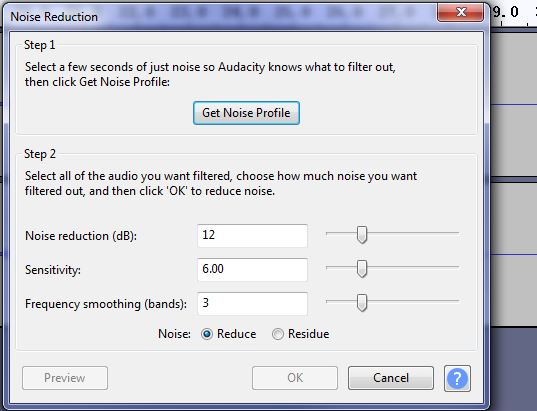
I then tried the default noise reduction setting in Audacity and here is the result:
Well, I’ve always been convinced that the private party is the best format to organize a baroque concert. Too bad this venue is now temporarily closed because of the quarantine. 
I’m not the greatest expert on sound of strings, but from my experience, when you hear the violin up close its sound is incredibly bright and even harsh. It is the reverb which gives strings that familiar lush and warm sound. So the first thing I’ve noticed is the lack of reverb.
I would say that for that close sonic perspective your version sounds pretty real. Even one violin in a small room can sound ear-splitting.
If you’re interested, I can offer a link to a recording which I consider to be one of the best. To my taste it is perfect, both artistically and technically.

You can also listen to the ensemble called Voices of Music. Their recordings are close to being perfect too.
Then I would suggest buying Zoom H1n for now. It is cheap and can solve your problem immediately.