The Old Film: Projector filter simulates mechanical and optical artifacts introduced during analog film projection, particularly common in home and educational projectors (8 mm, Super 8, 16 mm).
Unlike film grain or scratches, these artifacts do not originate from the film stock itself, but from the projection process: unstable film transport, uneven illumination, mechanical vibration, and inconsistent film development.
The result is an image that jumps, flickers, and fluctuates in brightness, often making projection highly unstable compared to modern digital playback.
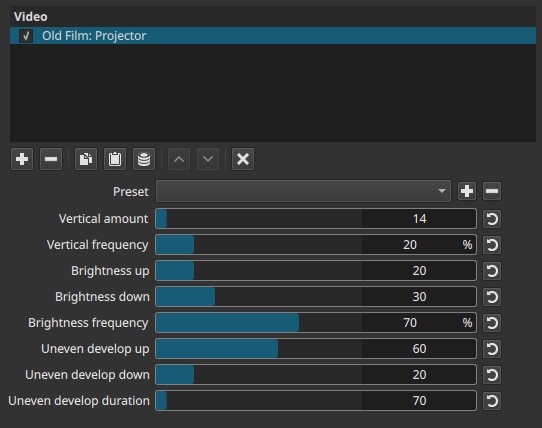
This filter recreates those characteristics for creative and nostalgic effect.
Parameters
Vertical amount (0 - 200)
Controls the strength of vertical image displacement.
-
Lower values
Subtle vertical instability -
Higher values
Strong vertical jumping, similar to misaligned film transport
This simulates frame misregistration caused by imperfect sprocket movement.
Vertical frequency (0% - 100%)
Controls how often vertical movement occurs.
-
Lower values
Occasional jumps -
Higher values
Frequent or continuous vertical motion
Brightness up (0 - 100)
Controls the maximum upward brightness fluctuation.
This simulates brief over-exposure caused by uneven projection light or shutter timing.
Brightness down (0 - 100)
Controls the maximum downward brightness fluctuation.
This simulates dimming caused by shutter occlusion, lamp instability, or film density variations.
Brightness frequency (0% - 100%)
Controls how often brightness fluctuations occur.
Higher values produce noticeable flicker, a hallmark of analog projection.
Uneven develop up (0 - 100)
Controls bright variations caused by uneven film development.
Simulates areas where film chemistry produced lighter regions.
Uneven develop down (0 - 100)
Controls dark variations caused by uneven film development.
Simulates density inconsistencies across the film strip.
Uneven develop duration (0 - 1000)
Controls how long uneven development artifacts persist before changing.
-
Lower values
Rapid, unstable changes -
Higher values
Slow, drifting brightness irregularities
Note:
Uneven develop duration controls how long the defect stays, not how fast it moves.
Parameter interaction
- Vertical amount + frequency simulate mechanical instability
- Brightness controls + frequency simulate projector flicker
- Uneven develop controls + duration simulate chemical inconsistencies in film stock
Combined, these effects recreate the imperfect, unstable viewing experience of projected analog film.
Visual characteristics
Typical effects include:
- Vertical image jitter or jumping
- Irregular brightness flicker
- Uneven exposure across frames
- Persistent brightness patches that drift over time
The image may appear distracting or unstable by modern standards, intentionally reflecting historical projection limitations.
Historical context
In home and school environments, film projection was often:
- Mechanically imprecise
- Poorly aligned
- Affected by worn projectors and lamps
- Sensitive to film wear and chemical inconsistencies
This filter reproduces that experience rather than the idealized film image.
Historical preset suggestion
8 mm Classroom Projector
Simulates mechanical and optical instability typical of home and classroom film projectors.
Suggested values (starting point)
- Vertical amount: 35 - 60
- Vertical frequency: 15 - 25%
- Brightness up: 10 - 20
- Brightness down: 15 - 25
- Brightness frequency: 20 - 35%
- Uneven develop up: 10 - 20
- Uneven develop down: 15 - 30
- Uneven develop duration: 300 - 600
Note:
These presets produce mild vertical jitter and irregular flicker typical of worn 8 mm educational film projection on poorly maintained projectors.
Recommended use cases
- Authentic vintage or archival simulations
- Educational or historical reenactments
- Memory or nostalgia sequences
- Stylized degradation effects
- Combining with other Old Film filters (Scratches, Dust, Grain)
Limitations
- Parameters are not keyframeable
- Effect is uniform across the frame
- Intended for stylization, not restoration
- Extreme values may reduce readability