Adds synthetic visual noise to the image to introduce randomness, texture, or signal degradation.
Unlike film grain simulations, this filter produces a digital-style noise that can be animated over time.
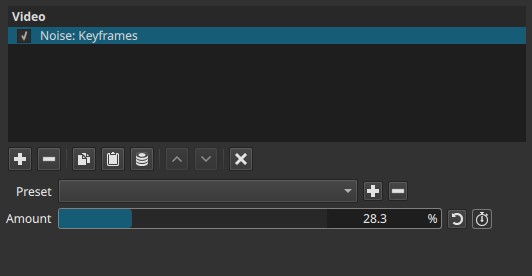
Noise: Keyframe is a spatial effect evaluated per frame.
Parameters
Amount (0.0 - 100.0%)
Controls the intensity of the noise applied to the image.
-
Low values (≈0.0 - 20.0%)
Subtle noise. Fine speckling is visible primarily in flat or midtone areas. -
Mid values (≈20.0 - 60.0%)
Clearly visible noise. Texture becomes apparent across most of the image. -
High values (≈60.0 - 100.0%)
Strong noise. A structured pattern may become visible, with noise appearing to align along rows and columns.
Notes:
- The noise is not monochrome; particles contain subtle color variation.
- At high values, the noise can appear grid-like or patterned, rather than fully random.
- Noise is applied uniformly across the frame; it does not respond to luminance or edges.
Keyframes
The Amount parameter can be keyframed.
This enables:
- Gradual buildup or reduction of noise
- Pulsing or rhythmic noise effects
- Time-based transitions between clean and degraded images
Visual characteristics
- Fine to coarse digital noise
- Slightly colored noise particles
- Uniform distribution across the frame
- At high values, visible structure rather than purely random grain
- Can reduce perceived image clarity and contrast
Recommended use cases
- Glitch or digital degradation effects
- Simulating signal interference or instability
- Adding texture to flat or synthetic imagery
- Transitional effects using animated noise
- Abstract or experimental visuals
Tips and usage notes
- Use low Amount values for subtle texture; higher values quickly become dominant.
- Evaluate the effect at full resolution, as noise structure is resolution-dependent.
- Keyframing small fluctuations in Amount often looks more natural than large jumps.
- This filter is not a replacement for film grain or photographic noise simulations.
Limitations
- Noise pattern may appear structured at high values
- No control over noise color, scale, or distribution
- No luminance-based or adaptive behavior
- Can introduce visible banding or patterning when overused