HQDN3D (High Quality DeNoise 3D) reduces noise by smoothing pixel variations across space and time. The “3D” refers to processing in two spatial dimensions (X, Y) and one temporal dimension (frames).
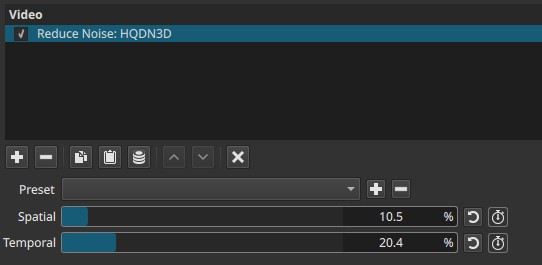
This filter reduces noise by averaging similar values, not by reducing precision or analyzing edges.
Parameters
Spatial (0.0–100.0)
Controls the amount of spatial noise reduction applied within each frame.
This parameter uses a normalized, unitless scale representing relative denoising strength.
-
Lower values
Minimal smoothing; preserves fine detail and edges -
Higher values
Stronger smoothing; increased noise reduction with potential loss of texture
Spatial denoising primarily targets:
- Grain
- Sensor noise
- Compression artifacts within a single frame
Temporal (0.0–100.0)
Controls the amount of temporal noise reduction applied across adjacent frames.
This parameter also uses a normalized, unitless scale.
-
Lower values
Little or no frame averaging -
Higher values
Stronger noise reduction over time
Temporal denoising primarily targets:
- Flickering noise
- Temporal grain
- Low-light shimmer
High values may introduce motion artifacts such as smearing or ghosting.
Keyframes
Both Spatial and Temporal parameters can be keyframed, allowing noise reduction strength to vary over time.
This enables adaptive workflows such as:
- Stronger denoising in dark or static sections
- Reduced denoising during fast motion
- Gradual transitions between noise profiles
Parameter interaction
The two controls operate on different dimensions:
- Spatial smooths variations within a single frame
- Temporal smooths variations between frames
Moderate values for both parameters typically produce better results than extreme values on either control alone.
Visual characteristics
Typical effects include:
- Reduced grain and flicker
- Smoother shadows and flat areas
- Loss of fine detail at high Spatial values
- Motion artifacts at high Temporal values
Recommended use cases
- Low-light or high-ISO footage
- Compressed or archival video
- Static or slow-moving scenes
- Footage where spatial-only denoising is insufficient
Limitations
- Not edge-aware
- May soften fine detail
- Temporal denoising can cause ghosting on motion
- High values are unsuitable for fast action or handheld footage