Opens a network-based media stream by providing its URL.
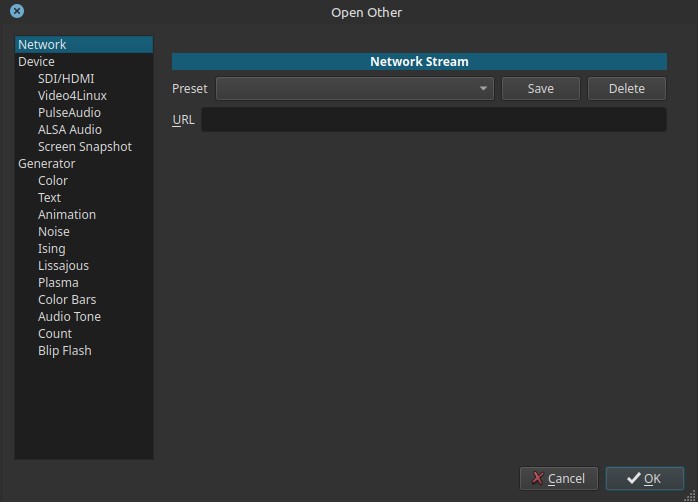
This feature is used to receive and play streams, not to broadcast or stream to others.
What a network stream is
A network stream is audio/video data transmitted over a network using a streaming protocol instead of being stored as a local file.
Common examples include:
- Live streams (TV, cameras, radio)
- Network cameras
- Media servers
- Test streams
- Local network streams (LAN)
Shotcut uses FFmpeg to open and decode these streams.
What this feature does (and does not)
It does:
- Open and play network-based audio/video streams
- Treat the stream as a live or linear source in the Source player
- Allows recording the stream using the Export panel; however, this is a transcode operation. Shotcut cannot directly save streams.
It does not:
- Stream video to another person or service
- Act as a streaming server
- Provide chat, conferencing, or live broadcasting tools
This is a receiver, not a sender.
Parameter
URL
Specifies the network stream address to open.
The URL defines:
- The protocol
- The server or device
- The stream path
Examples of supported protocols (depending on build and FFmpeg support):
http:///https://– progressive or streaming mediartsp://– IP cameras and live feedsrtmp://– live streaming serversudp:///tcp://– raw network streamssrt://– secure, low-latency streaming
Not all URLs or protocols will work; support depends on MLT, FFmpeg, and the stream itself.
Typical use cases
- Capturing a live IP camera feed
- Recording a network TV or radio stream
- Ingesting a live stream for later editing
- Monitoring or archiving network-based video
- Testing streaming workflows
Behavior in Shotcut
- The stream opens as a live source
- Duration may be unknown or infinite
- Seeking may be limited or unavailable
- Stability depends on network conditions
- Reception continues until stopped
Usage notes and tips
- Ensure the URL is reachable and accessible.
- Authentication (username/password) may be required for some streams.
- Network latency and packet loss can affect playback quality.
- Not all online video websites provide direct stream URLs.
- DRM-protected streams cannot be opened.
Limitations
- Playback depends on network reliability
- No authentication mechanisms other that what you can put in the URL
- No built-in stream discovery
- No broadcasting or sending capability
- Limited control over stream parameters
- Some formats or protocols may not be supported